Follow me
Pages
- Home
- Classes
- Portfolio
- New Hampshire
- Vermont
- Maine
- Published Photos
- People
- Birds
- Panoramas
- Annapurna Circuit in Panorama
- Bicknell Brook Panoramas
- Flights of Fancy
- Jiri to Everest Base Camp and Kala Patthar 2012
- Moose River in Winter
- Nepal in Panorama
- Nulhegan Basin from Lewis Overlook
- SRK Greenway 10 in Winter
- Star Lake Farm on Snowshoes
- Sunapee in Winter
- Early Snow on Smarts Mountain
- Lake Sunapee
- Lower Cascades
- Dartmouth in Winter
- Hardy Hill Brook
- Grafton Pond
- Mormon Barns
- Moose Mountain on Snow Shoes
- Baker Bush
- Mount Moosilauke
- Baker Bush Wetland
- Henniker Bagel Break
- Millstone
- Mount Kearsarge
- Central NH in Fall
- Willoughby Ski New Years 2010-11
- Mink Brook
- Gillingham Store
- Great North Woods Panoramas
- The Prouty 2011
- View from French’s Ledges
- Cardinal Flowers near Adder Pond
- Mount Cardigan
- Chapel at the Kingdom
- Minister’s Brook
- Skinner Brook
- River Road
- Bob’s Barber Shop
- Glacial Erratics Trail
- Nepal
- Annapurna Circuit Trek
- Arrival in Nepal
- Kathmandu and Patan
- Trip to Besi Shar
- Besi Shar to Bahundanda
- Bahundanda to Jagat
- Jagat to Dharapani
- Dharapani to Chame
- Chame acclimatisation day
- Chame to Pisang
- Pisang to Manang
- Manang acclimatisation day
- Manang to Yak Kharka
- Yak Kharka to Thorung Phedi
- Thorung La
- Muktinath to Jomson via Kagbeni
- Jomson and Marpha
- Fly to Pokhara
- Pokhara & Kathmandu
- Bhaktapur
- Kathmandu
- Faces of Bhaktapur
- Faces of Kathmandu
- Faces of Nepal
- Distributing Jackets
- Annapurna Circuit Trek
- Special Subjects
- Created
- Weddings & Portraits
- Details
- Contact Jim
- Trails
- Blog
Images on this site
Get the Flash Player to see the slideshow.Blog Topics
Archives
- May 2013
- April 2013
- March 2013
- February 2013
- January 2013
- December 2012
- November 2012
- October 2012
- September 2012
- August 2012
- July 2012
- June 2012
- May 2012
- March 2012
- February 2012
- January 2012
- December 2011
- November 2011
- October 2011
- September 2011
- August 2011
- July 2011
- June 2011
- May 2011
- April 2011
- March 2011
- February 2011
- January 2011
- December 2010
- November 2010
- October 2010
- September 2010
- August 2010
- July 2010
- June 2010
- May 2010
- April 2010
- March 2010
- February 2010
- January 2010
Tag Archives: Nepal
Editing a View from Kari La
After a great morning hiking mostly uphill from 6,600 ft, we spent a very long time having lunch and waiting for it to start raining so we could experience trekking in the rain.
And we did just that most of the afternoon. We didn’t make it to our destination of Paiya for the night stopping instead at Kari La, a pass at 9,600 ft. We had been 2,000 ft higher a week earlier and in another week we would be at around 18,000 ft crossing the first of two high passes on our way to Kala Patthar and Everest Base Camp.
After checking into the lodge I wandered around with my camera. The rain had stopped and the Khumbu valley was opening up. It was going to be an interesting sunset after all—one of the first of the trip. I took a 3-shot panorama and then another peeking through the amazing trees at the distant mountain, Thamserku, and the colorful clouds. I’m using the single photo here as an example of how one can edit a photo to more closely resemble what the eye sees. One key here is the camera only records a limited dynamic range, around 5-8 stops of light (factors of two in brightness) depending on whether one is shooting JPEG or raw. Yet the eye can see 16 or more stops. We have a wonderful ability to squint at the bright parts of a scene and also see detail in the shadows.
The photo on the left is what my camera would have recorded if I was shooting JPEG. I shot this contrasty scene at f/16 (I wanted a lot of depth of field), 1/40 sec, ISO 800, and 36mm. I did not take the time to unpack the lightweight tripod I was carrying. I did take a few minutes to hang a few wet clothes on a line above a wood stove in the dinning room. In these lodges, it is important a claim a little bit of drying space as soon as one can.


You can see the JPEG capture produces a rather bland scene with the colors washed out and the tree mostly a silhouette. However, since I was shooting raw, I could significantly improve the image in the raw processing. I used Adobe Camera Raw (ACR) in Bridge which is the same processing engine found in Lightroom. The photo on the right is after the raw processing. I could have used ACR to process a JPEG version, as many people do mistakenly thinking they are getting the advantages of shooting in raw. That would have improved the photo somewhat, but not given me the detail and tonal range that I was able to get, and later utilize, by using the raw capture. And I could have worked harder processing the raw version and perhaps gotten to a slightly better place than the right hand photo. But this is really a job for Photoshop and layer masks, not the “fake” masks of the Adjustment Brush in ACR.
For the version below I started with the right hand image above and finished job in Photoshop (CS6). The master image I produced has 8 layers, 5 of them Curves Adjustment Layers with masks. One mask was hand painted, the others used the tonal information in the image to mask the adjustment itself. The purpose of the post is not to explain in detail the steps, rather to show what can be done when the original capture contains all the tonal information and the processing makes good use of what is available. In producing the final image which I believe is a fair representation of what I saw, I did not add anything that was not present when I took the photo.

Thamserku from Kari La
Incidentally, many “advanced” photographers would make multiple exposures of this scene planning to blend them later using High Dynamic Range (HDR) techniques. There is nothing wrong with this; I might have done it myself if I wasn’t so cold, wet, and tired. But many people apply HDR software to images that already have a full tonal range and hence can be successfully, and often better, optimized using more standard and less “automatic” techniques.
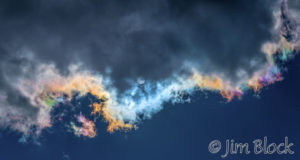
Clouds over Thamserku
Near the end of a month long trek in Nepal from Jiri to Kala Patthar and Everest Base Camp by way of two high passes, Renjo La and Cho La, and Gokyo, we set off one morning for a walk to Namche, “the Sherpa capital”, before carrying on to Monjo. Before even leaving “our” Danfe Lodge in Khumjung, we noticed some interesting and beautiful clouds forming in the distance to the south. But our trail took us downhill and for about an hour our view to the south was blocked.
When Thamserku (21,729 ft) finally came into view we were amazed that the clouds were not only still there, but they were more dramatic. They seemed to change shape every time we looked up. The show lasted for over an hour, but once we reached Namche our view was again largely blocked.


My 18-200 mm lens had basically died a week or so earlier, so I was left with a 50 mm lens on a Nikon D300s plus a Panasonic LX5, a great little camera. The images in the slide show that follows were taken with both, and many of the images are “panoramas” with between 2 and 17 individual photos stitched together to provide a single image.
The slide show that follows shows some of the formations we witnessed. Following the slide show is an image you can zoom into and pan around and explore.
You may explore the panoramic image below in detail. It is composed of 17 individual photos. You can double click to zoom way in then pan around. Please wait for the resolution to download. You can also use the + and – keys to zoom and the arrow keys to scroll. Or use the left mouse clicker to drag. Thamserku is to the left and the snow-covered range to the right is Kusum Kanguru (20,889 ft).
Posted in Nepal, Outdoors, trek
Also tagged 50 mm lens, clouds, LX5, Panasonic LX5, Thamserku
1 Comment
Back from Nepal
A small group of hearty souls spent a month trekking around the hills and mountains of Nepal recently. Rather than take the easy route—flying to Lukla—we walked from Jiri and then took a loop over two high (almost 18,000 ft) passes. We reached the summit of Kala Patthar, where we looked down at Everest Base Camp, then hiked into base camp the next day. On the way back I spend a morning and evening trying to photography the national bird, the beautiful Danphe. I haven’t looked at my photos from that day yet, but I doubt I got a shot that was as good as the one below from a previous trip.

Back home in time for migration I spent the morning wandering around both sides of the Connecticut River. I had the best luck in Etna at the King Bird Scantuary where I photographed a ruby-crowned kinglet and a broad-winged hawk carrying a chipmunk and in my own yard where a Nashville Warbler cooperated very nicely. Earlier I photographed a pair of bluebirds that appear to be considering nesting at the Milton Frye Nature Area of Norwich. Here as some of the photos from these areas.
Posted in Birds, Nepal, trek
Also tagged bluebird, Broad-winged Hawk, chipmunk, danfe, danphe, Eastern Bluebird, hawk, kinglet, Nashville Warbler, Ruby-crowned Kinglet
Comments Off
Annapurna Images Posted
I have posted photos and words from the first 70% of our 2011 trek around the Annapurna range in Nepal HERE.
There are quite a few photos on the pages linked to that page. If you only have a short time, here is a brief slide show.