Follow me
Pages
- Home
- Classes
- Portfolio
- New Hampshire
- Vermont
- Maine
- Published Photos
- People
- Birds
- Panoramas
- Annapurna Circuit in Panorama
- Bicknell Brook
- Bicknell Brook January 16, 2011
- Bicknell Brook January 6, 2011
- Flights of Fancy
- Jiri to Everest Base Camp and Kala Patthar 2012
- Moose River in Winter
- Nepal in Panorama
- Nulhegan Basin from Lewis Overlook
- SRK Greenway 10 in Winter
- Star Lake Farm on Snowshoes
- Sunapee in Winter
- Early Snow on Smarts Mountain
- Lake Sunapee
- Lower Cascades
- Dartmouth in Winter
- Hardy Hill Brook
- Grafton Pond
- Mormon Barns
- Moose Mountain on Snow Shoes
- Baker Bush
- Mount Moosilauke
- Baker Bush Wetland
- Henniker Bagel Break
- Millstone
- Mount Kearsarge
- Central NH in Fall
- Willoughby Ski New Years 2010-11
- Mink Brook
- Gillingham Store
- Great North Woods Panoramas
- The Prouty 2011
- View from French’s Ledges
- Cardinal Flowers near Adder Pond
- Mount Cardigan
- Chapel at the Kingdom
- Minister’s Brook
- Skinner Brook
- River Road
- Bob’s Barber Shop
- Glacial Erratics Trail
- Nepal
- Annapurna Circuit Trek
- Arrival in Nepal
- Kathmandu and Patan
- Trip to Besi Shar
- Besi Shar to Bahundanda
- Bahundanda to Jagat
- Jagat to Dharapani
- Dharapani to Chame
- Chame acclimatisation day
- Chame to Pisang
- Pisang to Manang
- Manang acclimatisation day
- Manang to Yak Kharka
- Yak Kharka to Thorung Phedi
- Thorung La
- Muktinath to Jomson via Kagbeni
- Jomson and Marpha
- Fly to Pokhara
- Pokhara & Kathmandu
- Bhaktapur
- Kathmandu
- Faces of Bhaktapur
- Faces of Kathmandu
- Faces of Nepal
- Distributing Jackets
- Annapurna Circuit Trek
- Special Subjects
- Created
- Weddings & Portraits
- Details
- Contact Jim
- Trails
- Blog
Images on this site
Get the Flash Player to see the slideshow.Blog Topics
Archives
- May 2013
- April 2013
- March 2013
- February 2013
- January 2013
- December 2012
- November 2012
- October 2012
- September 2012
- August 2012
- July 2012
- June 2012
- May 2012
- March 2012
- February 2012
- January 2012
- December 2011
- November 2011
- October 2011
- September 2011
- August 2011
- July 2011
- June 2011
- May 2011
- April 2011
- March 2011
- February 2011
- January 2011
- December 2010
- November 2010
- October 2010
- September 2010
- August 2010
- July 2010
- June 2010
- May 2010
- April 2010
- March 2010
- February 2010
- January 2010
Tag Archives: Lyme
Lyme Hill Conservation Area

I paid my first visit to the UVLT Lyme Hill Conservation Area yesterday afternoon. I wasn’t expecting to see much so I just carried a camera with a “walk-around” lens—no tripod. I mostly wanted to take a quick look at this relatively new area that I knew connected to the wonderful trails along Grant Brook near the Connecticut River.
I studied the trail map at the kiosk and decided I only had time to hike to the wetland area. Lyme Hill itself and the trails to Grant Brook would have to wait for another visit. A short distance down the trail I could see a small brook well below me. It obviously drained with wetland and was a tributary of Grant Brook. I made a mental note to come back with a tripod when the slope wasn’t so slippery—there were some nice small falls that needed their picture taken.
Entering the woods I crossed the brook on a well-built bridge and climbed a hill. As I headed down the trail to the wetland, still slippery with the remains of the snow that our extensive January thaw hadn’t fully melted, a group of polypody ferns were glowing backlit on top of a large rock. These are one of the few ferns that grow in thin soil on rocks. In summer their spores are fun to photograph with a macro lens.
I love shooting into the sun, and these ferns were is an ideal situation. The background was far away and dark. Thus contrast was naturally very high, and shooting wide open the background would be blurred. Plus there was a handy young tree just to the left behind the ferns that I could use to keep the sun from hitting my lens and causing flare if I positioned my lens just right. When I see such a situation I grab the opportunity that is presented to me.

Farther down the trail a pair of large rocks (glacial erratics?) caught my attention. One glistened white while its neighbor was dark with interesting textures. I photographed the front one and then used it to brace my camera for a photo of the darker boulder.


I finally reached the wetland and surveyed the scene quickly. Nothing was moving. I made a few photos of the reflections in the water that had pooled on the rapidly softening ice.

I scanned with my camera. A beaver lodge on the far shore. Then a very long beaver dam. Then a “beaver” sitting on the ice looking at me! My first thought was actually “otter”, but with the lodge and dam I figured beaver. I squeezed off quite a few shots in 8 seconds before it slid out of sight though a small hole in the ice right in front of it. I figured it swam for the lodge because I never saw it again. It took a while but after getting some ID help I now realize I was fooled by its surroundings and I actually photographed a river otter.

The photos below show the otter with the beaver dam in the background and the beaver lodge.


I plan to go back many more times. Hopefully winter will return and snowshoes or xc-skis will be my mode of travel. I need to make it to the top of Lyme Hill and down to Grant Brook sometime soon. In spring the brook with its series of small falls should definitely be worth exploring.
Posted in Hike, Photography Tips, Wildlife
Also tagged beaver, Lyme Hill Conservation Area, NH, polypody, UVLT
Comments Off
Wood Duck Family
A trio of wood ducks swam in the early morning light in Lyme, NH this morning. The adult male was molting. The female kept watch over the juvenile male. It was a good opportunity to observe three feather designs, all different than the typical male wood duck portrait.
For identifications purposes, here is the trio in one frame. The juvenile male is in the lead, of course. He is followed by mom and the more cautious dad. A slide show follows.

You can see more wood duck photos from the same spot by clicking HERE.
Posted in Birds, Wildlife
Also tagged juvenile wood duck, molting wood duck, New Hampshire, wood ducks
Comments Off
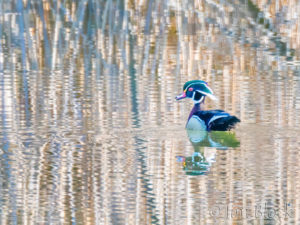
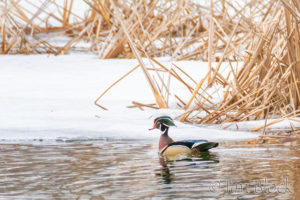
Wood Ducks on Clay Brook
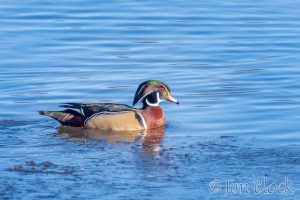
The morning was cold, dark, wet, and foggy around Post Pond. I vertured into the Chaffee Wildlife Sanctuary hoping to photograph wood ducks. Several males flew by and a female drifted in the distance barely noticable in the fog. Suddendly a group of males energed from hidding across from me and no sooner did I spot them but they were gone. So I knew if I was just patient…
After what seemed like a long time standing at the water’s edge—in fact a bit in it—I decided to try another spot farther to the north. Another fly-by or two and then a pair swam into view from downstream. They stayed in sight a while, not flushing like is so common for the species. So I got some photos.

A male swimming alone.

And a female.

Shooting JPEG and just taking what I could get would have resulted in this dull images. (This is a straight default version of a RAW file which is roughly what a JPEG capture would look like.)

But I was shooting RAW, as I always do, and adjusting the capture in non-destructive Adobe Camera Raw in Bridge resulted in a much more pleasing version of the same photo.

Posted in Birds, Photography Tips
Also tagged Clay Brook, New Hampshire, Post Pond, Wood Duck
Comments Off
Peregrines fledged
Peg Ackerson and I returned to Holt’s Ledge recently to check on the progress of the three peregrine falcon chicks that Chris Martin banded earlier this year. The chicks had fledged and looked healthy. All were out of their eyrie and flying, although after a quick pass near us by one, they made themselves scarce. Nonetheless, I captured a few shots of one flying and then stayed to photograph their parents as they performed guard duty. You can see a slide show of photos from the morning HERE. Or you can see the 2009 and 2010 banding and site overview HERE.
Here are two of the chicks far from me, perhaps staying close together for security.

Here is the father making some passes at us to let us know we should not try to threaten his young.

And here is the mother standing guard in one of her favorite trees.