King Hill Reservation

A family ski area where many, including yours truly, first took a successful downhill run, King Ridge Ski Area in Sutton NH is now a conserved area for hiking, bird watching, and cross country skiing. The former ski area has been divided into a luxury home development at the very top of the hill and a 441-acre preserve owned by the Town of Sutton with the Ausbon Sargent holding the conservation easement. Trailheads are found along Hominy Pot Road and Kings Hill Rd. We entered from Hominy Pot Rd. found 0.2 mile east of Exit 11 off I-89. A small parking lot is exactly 1 mile from NH Rt. 11 just beyond the interstate crossing, but it is easy to miss because the sign is partly hidden.

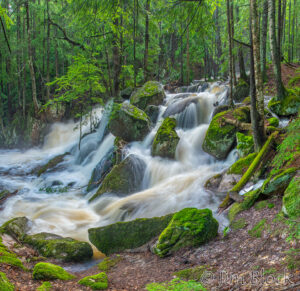
The area seems to be infrequently used. I have been there a number of times for bird photography and yesterday for a hike with Jann and have never seen another visitor. Many of the trails are level and easy, but some climb the former ski slopes. The trail along Lyon Brook is especially nice. We have had a hot dry summer so the brook was just barely running—more like trickling among the exposed rocks.


Streams filled with water are exciting to photograph, but the dark exposed rocks with bright reflection in the pools made interesting subjects.

We approached a well-made bridge over Lyon Brook, and I set up to make a multi-shot panoramic image. I shot 5 images with the camera oriented vertically on a tripod and used 4 of them for the composite below. In this way one can make the lens effectively wider and still maintain a “normal” aspect ratio.

After crossing the bridge we emerged from the forest into a field filled with milkweed and some migrating warblers. But we suspected we were off the reservation so we returned to a wide path along an old stone wall. The light was very contrasty so I made three bracketed exposures two stops apart and merged them using Photomatix Pro.
I had been using a polarizer and when I aimed my lens at a small piece of the brook, I saw a dramatic change in the image as I rotated it. I’ve seen this many times before, but a side-by-side comparison of such images can be a huge surprise to those who do not use one. Here are two views of the same subject taken 9 seconds apart. All I did was rotate the polarizer.

Finally an unidentified caterpillar. Anyone know the species? There was a stem next to this one that had been stripped of leaves. Could be this is the culprit and it moved next door to continue eating.

Posted in Hike, Nature, Photography Tips Tagged , , |

Second Century

August 28, 2010, second one of the year (and of my life). Extended myself this time—the ride was 102.4 miles long. But first a brief bungee jumping story.

Jann and I spent 33 days touring New Zealand in 1998. I had a notion I would try bungee jumping. We checked out a few spots, but none passed inspection (read, courage was still lacking). Finally it was do or die (or perhaps both). From a platform high above a river I took the dive and afterwards received a “Certificate of Courage” with a 50%-off-your-next-jump coupon. Wanting to prove the first time wasn’t a fluke, and because I can’t resist a bargain, I jumped again—after pondering my decision overnight.

So when I finally did a Century Ride a month ago, I knew I needed to do another one soon. But visitors who helped us enjoy this wonderful summer delayed my plans until Saturday. I left Burkehaven Harbor just before 6 am (and before dawn). The day started cold, foggy, cloudy, and dark (I guess they all start dark). Next time I’ll bring full-fingered gloves and a windbreaker. Heading up Route 10 from Newport I took this photo.

In Croydon the sun rose above the hills, and I stopped briefly at Spectacle Pond and took a 5-shot panorama. Below are two of the images shot with my trusty LX3 and stitched with Photoshop CS5. As with the first century, the LX3 hung around my neck and one shoulder ready for action. I carried a tiny tripod in my “trunk” that is useful for taking photos to show that it was actually me doing the ride.

The low sun allowed me to make a “self-portrait” while riding. But I stopped to make a 4-shot pan of a sheep farm field in backlight on the northern edge of Croyden. Here are all four images merged.

For a while the sky was filled with clouds, then suddenly, almost magically they were gone and the rest of the day was a beautiful sunny blue-sky summer day. Two images that show the early clouds, also stitched from multiple captures, are below. Both were taken in Springfield, NH.

Further along beautiful, but underappreciated, Route 4A there is a very nice pond/wetland just short of Gile State Forest. Here are two photos of this spot.

I crossed I-89 for the second of four times and stopped for a brief rest at Gile Pond in Sutton. I was serenaded by three loon who were fishing together but seemed to have a bit of a disagreement. The LX3 has a great lens, but it is not a telephoto. So my shots of the loon have them very tiny in the frame. Even at the low resolution of web images they wouldn’t look that good. So please imagine a tight group of three. I did set up my camera on a tiny tripod on the ground to document my bike and its rider.

Leaving North Sutton I passed through Sutton Mills and South Sutton, skipping South Sutton. Roby Road took me into Warner, then along Rt. 103 back into Sutton then Warner again. Crossing I-89 I spotted an old cemetery in between the north and south lanes of the interstate! Beyond that was the buffalo place where I had been three day in a row: first on my bike, then back with DSLR camera and long lens to photograph and make some purchases, and finally to just photograph part of the sign along the road. The buffalo photo is the only one here not taken with the LX3.

Rides were being set up at the Hopkinton Fair grounds. I took a right just before the Contoocook River then climbed over the large flood control dam that creates a series of lakes and parks in Hopkinton.

I finally arrived in Henniker and picked up a long-anticipated “Everything” bagel with cream cheese at a favorite ride stop. I enjoyed one while sitting along the Contoocook River with 25 miles to go on my first century ride, picked up one to snack on along several shorter rides since, and savored one in a small park in town this trip. Since I was not moving I could sit and really look at my surroundings—something more conducive to photography than just shooting. Interesting patterns started to emerge as I sought to alternately avoid and use the strong mid-day sun and resulting high contrast. Here are three photos I took as I finished the bagel.

Henniker is home to New England College, and town was alive with students and visitors. A large home advertised “3BR apt, same price as dorms” and I rode back northwest along a wide and smooth section of Route 114. Earlier segments on Route 114 from Grantham to Springfield and then again through Sutton were quite bumpy with no real shoulder, but fortunately with very little traffic.

I took a side loop to a beach on Lake Massasecum where I took a quick 6-shot pan. CS5 is amazing for what it can do piecing together pans that would have been impossible to shoot so quickly and sloppily just a few years ago.

At the beach I found some interesting tree bark.

Leaving the beach a heard a loud roar from the main road (Route 114) above me to the south. I was surprised that the road seemed so close from the intensity of the noise. When the noise continued unabated I realized it was from a long line of motorcycles. I hurried to the intersection when the side loop met 114 and stopped to watch them go by. It seemed like the line of bikes travelling at 55 mph went on for over 5 minutes–must have been many hundreds of them.


The long climb into Newbury was ahead. As I started up the more gradual part I heard an “on your left” as another rider, whom I saw approaching in my mirror, drew alongside me. We chatted as I sped up and he slowed so we could pedal side-by-side. He was doing a quick 40 miles to train for a triathlon. Today he was doing power—pedaling only in high gear. Tomorrow he would pedal at as high a cadence as possible in very low gears. His turn-around point was the chicken farmer—the painted sign on a rock that had been there as long as he and I remembered, and he grew up nearby. “Chicken Farmer, I still love you.” This also roughly marked the spot where the road got steeper. Riding with him made those few miles just fly by. I enjoyed his company and I hope I didn’t slow his training pace too much.

I stopped half way up the steep part to visit one on my favorite spots along Andrew’s Brook. It has been a great summer, very warm and dry. But dry leads to little flowing water, and the light was very contrasty anyway so normal photos wouldn’t work well. I love to photograph moving water at slow shutter speeds (using a tripod, of course) on overcast days. What sometimes works when a scene has high contrast is to set your camera to as small an aperture and as low an ISO as possible and move the camera during the exposure. I tried some of these. Here is one, followed by the same scene without moving the camera.

Almost there. A cruse through Newbury Harbor, a few ups and downs to Sunapee Beach State Park, along Route 103 to Guild (I normally skip the narrow 103B), then back up route 11 to Sunapee. I took a side road to Dewey’s Beach, then along Garnet Street to Sunapee Harbor where I quickly snapped an old car as we passed each other heading in opposite directions. Keeping my camera around my neck is a slight annoyance while riding but one I readily put up with so I can get photos I would miss if it was in a bag.

The total time from start to finish was 8.5 hours with 7 hours spent moving and 1.5 hours for photography and a bagel.

Will I do a third century ride this summer? Perhaps. If you would care to join me, please let me know. If you would like to read about my first Century Ride, please click HERE.

Posted in Biking, Photography Tips Tagged , , , , |

Digital Cameras

The digital camera revolution continues.  DSLRs have reached unthinkably high ISO levels with amazing quality, EVIL cameras are becoming serious tools for those who like to travel light, and megapixel madness continues with many P&S cameras. Choosing and using the “right” camera is more complex every day. Here are some facts and opinions as of mid-2010.

I roughly lump digital cameras into three types: digital single-lens reflex (DSLR) cameras, mirrorless interchangable lens cameras, and point-and-shoot (P&S) cameras.

Digital single-lens reflexes represent the current “high end”, serious photographer camera. They are the largest and heaviest of the three types and are capable of producing amazing images under conditions unthinkable 10 years ago. They have large image sensors which translates to low noise at elevated sensitivity (ISO). Most brands have a very extensive choice of high quality lenses. When asked which camera to buy I recommend folks first look at and feel the offerings from Nikon or Canon. Feel? Yes, it is not unreasonable to choose a camera based on usability–how it feels in your hands, how easy it is to work the controls, and whether the things you want to change often are on dials or hidden in menus. I use Nikon DSLRs (I have purchased 5 and currently own 3), but I do not recommend Nikon over Canon—both have strengths and weaknesses.

As an example of what a DSLR can do under trying conditions, here is a photo I took recently during a magazine assignment of a contra dance in a dark gym.  I shot this at ISO 3200, 1/80 sec. f/2.5, handheld. Yet the noise level is very low. You can’t get this with a point-and-shoot.

The newest kids on the block are EVIL cameras, one of the many acronyms being proposed for small mirrorless SLR-like interchangable lens cameras that have been introduced by several manufacturers. These cameras replace the bulky mirror and “reflex” assemblies of a SLR with an electronic viewfinder, hence the acronym for Electronic Viewfinder Interchangable Lens camera. These cameras have large sensors comparable with DSLRs, although in many cases a bit smaller than those in most DSLRs.  This translates to much less noice at elevated ISO than P&S cameras. Yet they are small and light, or they can be—some of the early ones are not all that small. Currently the choice of lenses is very limited—probably my major reason for not buying one of these cameras at this time—but more lenses are being introduced for these cameras frequently. They use contrast detection focusing, hence auto focus is slow compared with a DSLR—another reason to wait. And they are not inexpensive. Yet if you want DSLR quality, need to travel light, and can live with a limited choice of lenses, these cameras are worth  considering. Many are also excellent for making HD videos. For now my all purpose trekking system is a DSLR—Nikon  D300s with 18-200 VR lens (also HD video-capable).

The third and largest category I simply refer to as point-and-shoot  even though some of the cameras in this group  are much more capable than the term point-and-shoot might imply. These cameras have small sensors, hence considerable noise if you boost the ISO (or choose auto-ISO). And the marketing departments of many camera manufacturers feel more is better so they keep pushing the pixel count higher and higher exasperating the noise problem. Meanwhile the clever engineers have built into the cameras an automatic way to minimize noise—they blur the image. In a P&S, a camera with fewer “megapixels” will often produce a better quality image than you might get from a camera with more. If you want to make 20×30 prints, 14+ MP might be nice, but most who use a P&S never print this large.

Because P&S cameras have small sensors, they can be made very small and light, and small high quality lenses can be manufactured quite inexpensively. However, their small size limits the aperture range available in these cameras (for technical/physical reasons), hence control of depth of field is difficult even if you get a camera that allows you to choose the aperture. Manual focus is also difficult with P&S cameras and using a polarizer is challenging to say the least. Still, I feel “everyone” should have a P&S, in addition to a larger camera, if only to guarantee one camera is always with you.

The choices among P&S cameras are many. I tend to favor one manufacturer, Panasonic. I have purchased two Panasonic P&S cameras for myself (and plan to soon get a third) and have purchased others for my wife and grandson. The variety of choices even within this one line is huge ranging from simple auto-everything, to large zoom range compacts, to sophisticated models geared to those who use a DSLR as their main camera. My personal choices—the Panasonic LX2, LX3, and LX5—are not for everyone, but they have the features that appeal to me:  modest pixel count (around 10 MP), great image quality, relatively low noise, ability to shoot RAW (a must for me), a very fast lens (f/2), wide angle (but limited telephoto), great macro focusing, movable focus spots, aspect ratio choices without cropping, and all the settings I make normally easily accessed by knobs and buttons rather than menus. I used the LX2 for several years before I sold it to get an LX3. I expect I will sell my LX3 and buy an LX5 within the next month. Yet, all three of these models are superb cameras—I’d be happy to travel with any of them in my pocket.

I’ve had images taken with the LX2 published. Here is one example which filled most of a magazine page—a photo of a conveyance that should not be used on the Appalachian Trail, even in summer. I got this photo because my LX2 was in my pocket when I went xc-skiing on the AT, and the 16:9 aspect ratio that the camera captured worked very well for this image.

The LX3 specs in some ways seemed to be a step down from the LX2, in particular a smaller zoom ratio. But the camera is definitely  a step up. I got it partly because of its fast lens (the  fastest of any P&S and faster than all but one of my current DSLR lenses). I love it for its ability to make wide angle macro images with a small depth of field, a challenging and fun combination. And of course I carry  it “everywhere”. Here is an example. 18

So, what camera is right for you? If you are serious about photography consider a DSLR system from Nikon or Canon and a P&S  and/or a mirrorless interchangable lens camera. If you want high quality and low weight and don’t need fancy optics or fast focusing, consider a mirrorless interchangable lens camera. If you just want to take photos and just want to point-and-shoot, almost any P&S should serve you well, but I would suggest you trade off zoom range, size, and price and favor fewer MP rather than more.

Many more photos taken with the Panasonic LX3 camera can be seen by clicking on each of these links in turn: photos I took during the first 15 days I owned the LX3, photos taken while mountain biking  this spring,  photos taken during a Century bike ride at the end of July, and photos taken during a second century ride late in August.

Posted in Photography Tips Tagged , , |

Birding in Newbury, NH

I searched in vain for migrants in a small area of wetland and forest in Newbury this morning.  But I managed to find some birds that I believe are residents. On the way there I got a few quick photos of a pair of loon. Here are some of the photos I took followed by the species list in order.

Black-and-white Warbler

Black-throated Blue Warbler

Blackburnian Warbler

Chestnut-sided Warbler

Black-throated Green Warbler

Northern Waterthrush

Hermit Thrush

Common Loon

Posted in Birds Tagged , , |

Mount Kearsarge—a summer tradition

Every summer for over 10 years my grandson, Julian, and I have hiked Kearsarge.  In the earlier days we would take the easier Rollins Trail from Warner.  But now it is always the same route—up the steep (1.1 mile) Winslow Trail and down the longer (1.8 mile)  Barlow Trail. Here are some photos from our 2010 trip. I call the Winslow Trail the Roots-and-Rocks route. Perhaps you can see why.

Posted in Hike, Outdoors Tagged , |

Hike to Lake Solitude

Lake Solitude, high on the Sunapee range, is a beautiful spot that few see. It takes a hike of an hour or so to reach. Along the Newbury Trail, the first leg of the 75 mile SRK Greenway ring of trails, there is a nice lookout over Lake Sunapee. Below is a view from this spot.

Up the trail above Lake Solitude are the White Ledges which offer a great view of Lake Solitude and NH to the east. Here is that view.

If you click either image you will be taken to a version that you can zoom in and explore. But be sure to return here to see the slide show of the hike I took recently with my grandson, Julian.


Posted in Hike, Outdoors Tagged , , , |

Hike to French’s Ledges

Recently my grandson, Julian, and I hiked to French’s Ledges from the Plainfield Elementary School. This was my first visit to this wonderful Upper Valley Land Trust spot. It had been on my “go to soon” list for years, but sadly that didn’t happen sooner. Now that I have “discovered” it I plan to go back often, likely riding my mountain bike.

Here is a slide show of photos I took during our early morning walk. Below the slide show is a panoramic view from the ledges. You can click on that image to get to a version you can zoom in and pan around.

Posted in Biking, Hike Tagged , , |

Century Ride—for real this time

Three decades ago I blew my shot at fame and fortune—and regretted it ever since.  On Friday July 30, 2010, I finally got some redemption.  I went out and just did it, documenting the accomplishment with camera and GPS.

Back in the dark ages, before “technology”, WiFi, cell phones, digital cameras, email, and a full 10 years before Photoshop, my daughter, Heather, and I set off on a Century ride in western Maine.  My family was staying in a rented cabin on Rangeley Lake.  Heather and I did 80 miles of the ride and arrived back at our cabin for a short rest. The lounge chair was so comfortable I let Heather do the last 20 miles, a circuit of the lake, alone. I have always said I do not regret things I have done, only things I have not done. This was certainly a prime example.

Interestingly, Heather’s memory of our ride was kinder than mine. In a recent conversation with my wife, Jann, she commented that she remembered we did the whole 100 miles together. It was only when Jann said it was otherwise that she remembered doing the loop on the partly unpaved road around the lake herself.  Heather’s memory includes the recent comment, “I remember the 80 mile loop being very hilly, and I was thinking we could have picked flatter terrain to ride that far on.”

Somewhat after that our family rode less and less, Heather and  her sister, Jennifer, went off to college, and the four old 10-speed bikes were relegated to storage.  When I purchased a mountain bike 30 months ago, it had been over 25 years since I last rode a bike. A road bike followed this spring and now I ride both as often as I can, perhaps averaging twice a week since spring. So gradually the thought of trying a century ride this summer returned, helped along by a friend who suggested he was thinking of trying one.  I hope to join him on that ride when his bike frame returns from the factory.

Another friend who is an expert rider (and the one whose talk about the joys of road biking while we xc-skied together last winter got me to buy one), suggested I should do an 80-mile trip before I attempted a century.  (My longest to that point was 67 miles.)  She also told me how to prepare the week before and what to eat the few days before the ride. She suggested the ride would be much easier with a SAG (supplies and gear) Wagon, a vehicle that meets the riders at various places with food, water, encouragement, etc. And it is better to not do the ride alone. I naturally ignored all this good advice figuring I should just do it or I might never make the time.  So I did.  This time I made sure I was 30 miles from “home” when I hit the 70 mile mark.  No lawn chair to grab me this time.

I covered 100 miles finishing by 3 pm Friday. Time spent riding, according to my GPS, was 7 hours and 28 minutes.  The remainder of the total 9 hours was spend taking photos, stopping for a bagel in the only Henniker on earth, and visiting the Abbott Library twice.  I dropped off an excellent 4-DVD set called “Life” at the start of the ride and picked up a DVD called “Misery” near the end at this small but excellent library in Sunapee.

My day began with a very cold boat ride from Great Island, where we have a small 110+ years old cabin, to Burkehaven Harbor where my car and bike were parked.
I started my GPS, slung my trusty LX3 camera over my head and left arm (where it stayed ready for action the whole ride and was used to take all the photos here during the ride), adjusted my mirror and I was off before 6 am. I stopped along Lake Avenue to observe the rising sun.  When I reached downtown Sunapee the bank thermometer read 46 F.

Heading in Newport I photographed a shop 

and Lity Pond in the early light.

The ride took me through two major watersheds and the towns of Sunapee, Newport, Croydon, Grantham, Springfield, Andover, Wilmot, Sutton, Warner, Bradford, Henniker, and Newbury.  I circled but did not enter New London and came within about 1000 feet of Goshen. During the ride I made a special detour just to enter Warner then to my surprise the route took me into and out of Warner three more times!

My route is shown on the GPS-recorded readout below (Northeast is up so it will fit better). If you click the map it will open larger in a separate window so you can better examine it (if you care) and even download it. Riding up all the big and small hills shown on the route profile below the map, I gained 1.4 MILES in elevation and, since I rode a loop, also glided downhill the same total vertical distance hitting a peak speed of 37 mph.  In contrast the much shorter and “easier” ride up Mount Washington gains less than a mile in elevation and is only 15% of the length of the ride I took.  But of course the ride up Mount Washington is steadily uphill at a pretty good pitch.

Turning north in Newport I headed up Route 10 through Croydon and Grantham as the sun rose over Camels Hump (the NH one) and Colt Mountain (mountain?) to the east.

I checked my GPS occasionally, still 88 miles to go, and photographed my shadow distorted by the early low sun as I rode.

Entering Croydon I passed Spectacle Pond

and a farm with sheep grazing in backlight. Backlight is probably my favorite light directions. It is wonderful for “fuzzy” things, can by dramatic for scenes, and, if one must photograph flowers in the sun, it is great for many flowers.

Mile 25, a quarter of the way, I completed a climb into Springfield and stopped for a few photos at the strangely named, Kolelemook Lake.

After 35 miles I stopped in the small village of North Wilmot, which is located on the north shore of Kimpton Brook, to take a few photos. To my left was an array of historical buildings neatly painted. To my right in a yard filled with interesting items were real and artificial flowers and a toy horse head.

From North Wilmot it was mostly downhill to Sillyville (aka Cilleyville) in Andover where Route 4A, which started just west of Lake Mascoma, ends at Route 11. I’ve driven the length of 4A in fall stopping at many places and getting some nice foliage photos. It is one of the best “unknown” fall foliage locations in the area. Early morning can reward you with a moose sighting. Just east of the Cilleyville covered bridge is the Blackwater River and some small pools and rapids that make good photo subjects. Today I did not linger but headed up Route 11 to the Kearsarge Valley Road, one that interestingly is not “mentioned” on biking maps. This took me past Mount Kearsarge (no big surprise), the Country Club of New Hampshire (golf course), and under I-89 for my first snack of dried fruit and nuts along the shore of Gile Pond.

Although the loop into Sutton Mills is only a very short diversion, I impulsively took it turning suddenly before a huge new building that is being erected. Sutton Mills is a pretty village with a nice waterfall of the Lane River. As I entered the village I spotted a deer with fawn on the road ahead. I quickly reached for the LX3, zoomed in to the maximum magnification (which on this camera is practically no telephoto at all) and toggled the aperture to its widest setting (to get the fastest shutter speed since I did not need depth of field at the distance I would be shooting). The deer saw me but I got off a few shots while riding toward it.
The LX3 is an unusual camera. I like it a lot, but it is not for everyone. Features that are very attractive to me include a very fast lens (f/2) for a point-and-shoot camera, a nice wide angle (24mm equivalent) view, ability to make all the settings I need to make in a hurry without using menus (aperture, shutter speed, exposure compensation, focus point, among others), and a wonderful macro ability (at wide angle it focuses to less than a half inch). Its main drawback is a very short (2.5x) zoom range; it is mainly a wide angle camera. Of course it shoots RAW, something that is a must in any camera I would consider buying.

In South Sutton I took a left on Roby Road and unceremoniously passed the halfway point. Then I dealt successfully with some road paving as I headed up Route 103 toward Bradford. A left on the third piece of Route 114 of this trip took me past the packed Bradford Junction Restaurant. It was tempting to stop because over the years I have had great breakfasts there. I took a brief rest stop at the boat launch of Lake Massasecum. I did not ask the young woman checking boats for invasive weeds if she was checking them as they came into or out of the lake since Massasecum unfortunately has a large area of millfoil at its north end.


After pedaling for 70 miles I reached to the far point of the ride, by design approximately a 30 mile trip back to Burkehaven. There was no doubt about it now, I was going to complete a Century Ride (or be dialing 911). The Whaler was in Burkehaven Harbor so a phone call to Jann to come and get me was not in the cards. I photographed a bridge over the Contoocook River taking four horizontal photos and “stitching” them into a vertical image in Photoshop CS5. The bottom part of this photo is looking nearly straight down.

Back to Henniker and a search for a bakery for lunch. I didn’t find what I was looking for, but did find a sandwich shot with fresh-baked bagels. One “Everything” bagel was left and cream cheese filling sounded great. While waiting for it to be prepared and warmed I asked, “Could I get my water bottle filled?”  ”Do you want ice?”  ”You bet, thank you very much.”  So she and this small shop served as my SAG Wagon for the trip.

I rode the short distance to the Contoocook River, leaned my bike against a post at the edge of a parking lot, and gingerly climbed down over a few large rocks with my slippery bike shoes to a place where I could sit, streatch my acking legs, and enjoy the bagel. It was probably the best bagel I have had in my life, and not just because I had ridden 72 miles. It was GOOD.

The image above was stitched together from 15 individual photos taken with my LX3 while sitting eating the bagel.  The river is the Contoocook and the bridge leads to New England College.  If you click this image you will be taken to another page where you can zoom into the image, pan around, and examine details.

By the time I reached Massasecum again I felt I was going to die and perhaps be laid to rest in Pond Cemetery near the lake.

But I managed to mount my bike again for the long climb out of the Merrimack River Watershed to the Connecticut River Watershed and Newbury Harbor on the southern shore of Lake Sunapee.
Just beyond Newbury Harbor I stopped at a little-known gas station to check the air in my tires. This station reminded me of the way things were when I bought my first car–a red Nash Rambler. They didn’t have a Presta valve on their air pump but my tires felt fine, much better than my aching thighs, so I moved on.

Back in Sunapee, nearing death and considering if I would meet my maker before I finished, I was urged instead to meet his son. But I passed up the opportunity and headed  the final few miles by the harbor and around Lake Avenue back to Burkehaven Harbor. The tiny boat in the middle of the photo is mine.

I finished the ride with two half empty water bottles, half a bag of homemade dried fruit and nuts mix, and an unneeded energy bar (actually a Reese’s Peanut Butter Cup two pack). Got back to the cabin to an adoring wife who suggested two Aleves. I slept well and actually felt great in the morning.

Will I do it again this summer? Hope to, this time with someone to chat with and share the adventure. Care to join me? Just send an email or leave a comment.

Posted in Biking, Photography Tips Tagged , , , |

Mountain Biking 2010 images

My mountain bike now has two and a half seasons of wear on it.  My body experienced that in the first year I owned the bike.  But my riding ability and endurance have improved gradually, and roots, rocks, and mud do not hold the terror they once did.  Observing and learning from more experienced riders, I can now ride through water and mud, cross small logs, and navigate various obstructions.

Since falling seems to be part of mountain biking, I rarely carry a large camera that could badly bruise ribs.  But I almost always have a small LX3 hanging at my side.  It works great for quick photos when we stop, with a self timer for group photos, and even for action photos while riding along. Virtually all of the photos I take with this camera are at ISO 100 since the small sensors of all compact cameras are noisy at high signal amplification (ISO). But its fast f/2 lens helps with action shots. Below are some of my favorite images from 2010 taken while out riding a mountain bike.  You can see more if you click HERE.

Posted in Biking, Photography Tips Tagged , |

Boot Tree and Steam Engine, HDR examples

I recently photographed two curiosities in the Sunapee/Sutton area.  Both were surrounded by trees and both days were bright and sunny.  This is a deadly combination for creating a nice photo—the contrast is way too high and the shadows tend to “confuse the image”.  So I tried a 5-shot high dynamic range (HDR) blend.

HDR is a technique where you take multiple exposures (some brighter than normal and some darker) and use software to blend the images into a single version.  In this way one can tame the contrast; compress the dynamic range.  For quite a while I have used Photomatix to accomplish this blending and “tone mapping” since the HDR tool in Photoshop was much inferior.  However, with CS5 Photoshop’s “HDR Pro” tool is much improved.  So now I use both but still favor Photomatix in most cases.  The two example here were both created with Photomatix.

Since the creation of a single blended image from multiple captures involves getting them to align properly, using a solid tripod is very helpful.  But on these two occasions I did not have a tripod handy.  So I used a technique that sometime works well—high speed HDR. You set the shutter release mode to the  fastest burst possible, use auto-bracketing, and brace the camera as best you can so it moves as little as possible between exposures. If you are steady enough the software will be able to fix the misalignment.

HDR software has multiple sliders to control many features of the mapping of tones from the 32-bit initial image to the resultant 16-bit image.  How you choose to set these sliders has a major impact on the “look” of the image. One can go for a realistic look or a very unusual, somewhat painterly, look.  I did one of each in the following images.

This wood fired steam engine was abandoned near a quarry in Sunapee years ago.  It was used to haul stone up out of the quarry. I made no attempt at realism here.

The boot tree in Sutton is hard to find even if you are looking for it. It blends nicely with the surroundings at this intersection. There are a total of 5 boots; East Sutton is hidden  behind the tree in this view.

Posted in Photography Tips Tagged , , , , , |

Kayak and Cloud

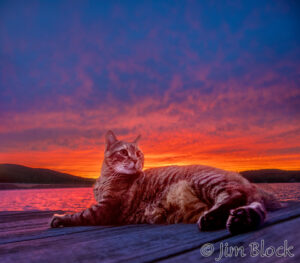
My grandson, Julian, is visiting.  We went for a kayak ride just before sunset.  The clouds were beautiful, and neither of us got wet.  Even our cat, Gatinha, managed to stay dry.

Posted in Kayak, Outdoors

Making Guitars

A few months ago I was asked to photograph a guitar-building class in Post Mills Vermont for Upper Valley Life, an excellent regional magazine.  Three students from three New England states worked with two instructors in a nicely equipped workspace.  One day I was there photographing I was treated to a live concert by a guitar duo.

I greatly enjoy making environmental portraits–photos of people in their work or play environments. My goal is to not only make a portrait but to show the individual’s relationship to their career, hobby, or lifestyle. The students at the school where not in their normal environment but were working with instruments they love so that is what I tried to show.

You can see some of the photos I took at the Vermont Instruments School by clicking the image below.  You can read the accompanying article by Sonja Hakala  HERE.

Posted in General, Photography Tips Tagged , , , |

Loons in Burkehaven Harbor

I very much enjoy photographing loons on quiet ponds at the crack of dawn.  When the water is still the natural reflections can add so much to the image.  I drift my kayak  in the general area of the loon, let it come to me, and shoot with a long lens.  But it has been a busy year, and I have yet to get out to photograph loon.  However, if you enjoy seeing photos of loons you might enjoy seeing some of my published loon images by clicking HERE.

This morning I photographed loons in a very different setting.  My daughter and  grandson were visiting. We were in small boat in Burkehaven Harbor of Lake Sunapee at about the time I would be calling it a morning at another spot. There was a pair of loons nearby. Since loons here see many boats moving by constantly, they are very relaxed around them.  So approaching quite close is easy, and photography is possible with a shorter lens without disturbing the loon. That is fortunate as all I had was a shorter lens than I would normally use.

The other interesting characteristic of the harbor and the morning was the unusual reflections behind the loons.  The sun was bright, the lake calm, and the boats and boathouses in the background colorful.  So the photos have a different quality—a mix of natural and man-made bright color.  Here are three photos from the 39 seconds (!) I spent photographing the the loons.

Posted in Birds, Nature, Photography Tips Tagged , , , |

Banding Bicknell’s Thrushes

In June I joined Chris Rimmer, Kent McFarland, and Pat Johnson  of the Vermont Center for Ecostudies on Mount Mansfield while they banded Bicknell’s Thrushes as part of an ongoing project.   It was foggy when we arrived, and as the afternoon and evening wore on it got foggier and darker, except for a brief clearing between 7:30 and 8:30 pm.  I got this photo of Smuggler’s Notch during that brief window.   If you click on this image you can read more about this adventure and see a slide show of the photos I took turning about 20 hour on the mountain.

Posted in Birds, Nature Tagged , , , |

Milton Frye Nature Area

Several years ago was when I first really appreciated the Milton Frye Nature Area in Norwich, VT. George Clark was leading one of his many very educational bird walks in Norwich. But this day was cold and rainy so attendance was very sparse.  We walked into the orchard and found quite a bit of activity but soon headed into the woods to search there and perhaps to partly escape the rain.  When we returned to our cars the rain had let up somewhat. I decided to head back to the orchard, this time with my camera and tripod.  George came with me to “spot”.

The apple trees were in bloom and  there seem to be multiple birds in each of them.  We were having a “fall-out”,  birds were grounded by  the weather and “trapped” by the cold and rainy conditions.   And there they stayed for three cold rainy days until the  weather broke. Then suddenly they were gone.  I saw species I had not previously seen,  Bay-breasted Warbler, as in the image below, among them.  It has not been as good since, but I try to return each spring when the apple trees are in bloom and birds are feeding on the insects among the blossoms.

In conjunction with a small exhibit of bird photos I have  hanging currently at the Norwich Post Office, I  put 30 of my favorite photos from the Milton Frye Nature Area HERE.

23-bx770-bay-breasted-warbler

Posted in Birds, Nature Tagged , , |

Pillsbury State Park Biking

I explored Pillsbury State Park in Washington, NH yesterday for the first time on a mountain bike.   I had kayaked and canoed there previously, but never tried the trails on a bike. Pillsbury is a little-know park, great for camping, kayaking small ponds, hiking, and mountain biking.  It is one of the few state parks in NH that permits mountain biking. Day-use fee was $4.

I chose the Bear Pond Trail first and rode it as far as the Monadnock Sunapee Greenway Trail before returning.  I found the Bear Pond Trail quite challenging.  It had numerous fairly steep uphills on uneven surfaces with loose rocks.  I did a piece of the Five Summers Trail and found it easy and pleasant—at least as far as I went.  I did not ride its whole length because I wanted to save time to do the Mad Road Trail loop.   This loop was very ridable and consisted of an old road, a piece of Rt. 31, and the unpaved road through the park.

It was a good morning and I will definitely return.  When I do I may start at dawn with a kayak on May Pond, but then will explore the  length of Five Summers Trail, Balance Rock Trail, and maybe some wood roads in the area on my mountain bike.

Posted in Biking, Outdoors

Rabbit in yard

Yesterday afternoon, on what may be the hottest day of the year, I walked into my garage from the house and saw a rabbit at the edge of the garage.  Surprisingly it only retreated a short distance and allow me to grab a camera and get some photos before a single bound took it out of sight in the tall grass (or wildflower meadow or weeds depending on your point of view).

I have not been able to conclusively identify the species of rabbit, so I’m hoping someone might see this post and tell me.  Here as a slide show of three images.

Posted in Nature Tagged |

Red-winged Blackbird Nest at Hanover Country Club

Mike Choukas alerted me this morning to the presence of a red-winged blackbird nest on the Hanover golf course. He gave me excellent directions, but I left them at home.  I got close by memory, but didn’t find it while ducking golf balls as a foursome passed by.  A member of this group told me Mike was in the following foursome, so I waited under a tree until he arrived.  After knocking hit ball on the green from around 150 yards out, he took me right to the nest, fairly well hidden a few yards out into the pond.  I didn’t want to stay too long and disturb the feeding or get hit by a golf ball, but I did get a few shots of the family.  Here is a brief slide show of the young and the parents.

Posted in Birds, Outdoors Tagged , , |

Peregrines fledged

Peg Ackerson and I returned to Holt’s Ledge recently to check on the progress of the three peregrine falcon chicks that Chris Martin banded earlier this year. The chicks had fledged and looked healthy. All were out of their eyrie and flying, although after a quick pass near us by one, they made themselves scarce.  Nonetheless, I captured a few shots of one flying and then stayed to photograph their parents as they performed guard duty.  You can see a slide show of photos from the morning HERE. Or you can see the 2009 and 2010 banding and site overview HERE.

Here are two of the chicks far from me, perhaps staying close together for security.

Here is the father making some passes at us to let us know we should not try to threaten his young.

And here is the mother standing guard in one of her favorite trees.

Posted in Birds, Nature Tagged , , |

Quebec Bike Trip

Recently an agreeable group of four traveled to the Eastern Townships of Quebec to spend two days biking the trails north and south of North Hatley.   On the first day we did a 33 mile loop from North Hatley to Sherbrooke and back.  The second day found us riding south on the Tomifobia Trail.  I have created three brief slide shows  of the trip.  You can assess each by clicking the images below in turn.

The Ride

North Hatley

La Chocolatière B&B

Posted in Biking, Outdoors Tagged , , , |